Sizing Chart
Why does your thumb hurt when you play
Pressing strings, plucking them, fretting. The base of your thumb is always under load. That's not a bad technique. That's just what playing requires. That's just what playing requires.
What matters is how much the joint has already absorbed, and how much it can still take.
You've run that same load through it for years. And the older you get, the less margin you have left.
The pain doesn't mean you've started playing badly. It means the joint is moving where it shouldn't be.
The real problem is a sliding thumb joint
Most doctors focus on the damage, not the movement. They see what's broken, not what's causing it.
The CMC joint at the base of your thumb is built for mobility, not stability. It depends on ligaments to keep it aligned.
Years of gripping under load stretch those ligaments. The joint begins to slide with every fret press, repeating the same faulty movement hundreds of times each session.
Arthritis, tendonitis, and wear and tear describe the damage. They don't explain why it's happening. The joint isn't just wearing out. It's sliding. And a sliding joint needs a different solution.
Play pain-free again
The Hand Stabilizer is a slim, contoured support built around the exact motion your thumb makes under load.
It stops the joint from sliding during the exact motion that's been causing the pain, while your other fingers stay completely free to play, type, and grab a coffee.
- Holds the CMC joint steady through every squeeze, reach, and stretch
- No metal stays, no rigid plastic, nothing that scrapes the neck or catches on a sleeve
- Left and right brace included, both hands covered
Most solutions mask the pain
Compression gloves distribute pressure evenly across the whole hand. The joint that's actually sliding gets the same squeeze as your pinky. It takes the edge off for a while, then stops working.
Rigid splints lock the thumb in place; no sliding, but no fretting either.
Cortisone, NSAIDs, and kinesiology tape. All target inflammation. None addresses the movement driving it. Play again, and you're back where you started.
The longer you stay on that cycle, the more damage accumulates. Inflammation settles, and cartilage keeps wearing. Nothing actually changes.
Designed & recommended by hand therapists
The Hand Stabilizer was developed with hand therapists who work with repetitive strain and joint instability.
The goal was simple: build something that addresses the problem's underlying mechanism, not just its symptoms, and that players can wear while they play.
- Get long-term results for a fraction of the cost of a single therapy session.
Frequently Asked Questions
How do I wear it?
How do I wear it?
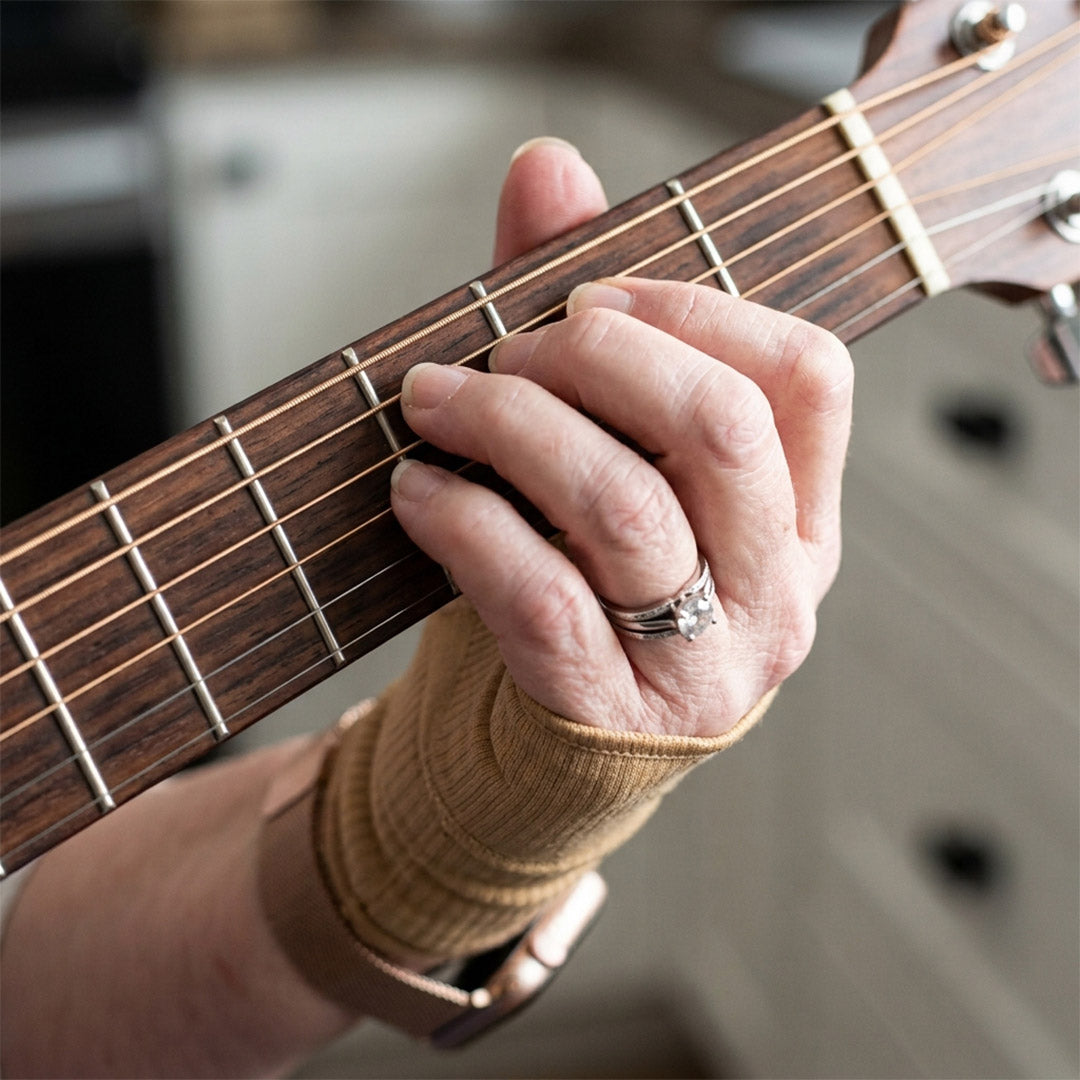
Put it on like a fingerless glove, making sure the firmer, contoured section sits snugly over the base of your thumb where it meets the wrist. Keep your four fingers free. Start with short sessions of 15 to 30 minutes so your hand can adjust. After that, wear it for as long as it feels comfortable.
How do I clean it?
How do I clean it?
Hand wash in cool water with a mild detergent. Lay flat to dry in the shade. Avoid direct sunlight, tumble dryers, and bleach.
What is it made of?
What is it made of?
Made from polyester, nylon, spandex, and a foam insert. It is latex free and contains no wool, lanolin, or animal derived fibers, making it suitable for those with alpha gal allergy.
Will it help my thumb pain?
Designed to support the thumb base and wrist area, where strain is common. It helps stabilize movement and reduce discomfort during activity, including conditions like arthritis, De Quervain’s, and trigger thumb.
This is not a medical device or cure. If you have a complex condition, consult a specialist.
Do I get one for each hand?
Yes. Every order includes a left and a right. We do not sell single sides or matching pairs of the same hand.